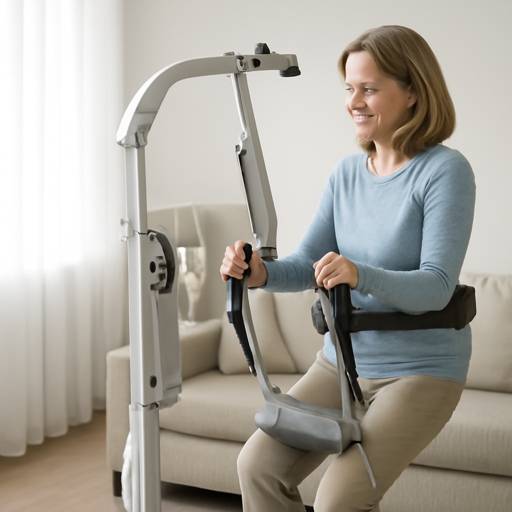
For individuals recovering from surgery, managing a chronic condition, or experiencing age-related muscle weakness, the simple act of standing up from a chair or bed can become a daunting challenge. This struggle not only affects personal dignity but also places significant physical strain on family caregivers who assist with transfers. The solution lies in a specialized piece of assistive technology: a sit to stand lift for home use. Unlike full-body sling lifts, these devices are designed for patients who can bear some weight on their legs and have some upper body strength. They work by providing a stable pivot point, a knee block for support, and a gentle lifting motion that guides the user from a seated to a standing position. This article explores the mechanics, benefits, and practical considerations of integrating such a lift into a home environment.
Understanding How a Sit to Stand Lift Transforms Home Care
At its core, a sit to stand lift functions as a mechanical extension of a caregiver’s strength. The device typically consists of a sturdy base with wheels, a vertical mast, a padded knee pad, and a harness or vest that wraps around the user’s torso. The patient begins in a seated position on a chair, wheelchair, or bed edge. The lift is positioned in front of them, the knee block is placed against their shins, and the harness is secured around their chest or back. When the lift is activated—either manually or via a battery-powered motor—it gently raises them to a near-standing posture. This motion is controlled and steady, reducing the risk of falls or sudden jerks that often happen during unassisted transfers.
The key advantage of this equipment in a home setting is its ability to preserve the user’s residual mobility. Unlike a patient who is completely non-weight-bearing, someone using a sit-to-stand lift actively participates in the transfer. This engagement helps maintain muscle tone, balance, and circulation. For caregivers, the lift eliminates the need to bend, twist, or support the full weight of another person, dramatically lowering the incidence of back injuries. Many models are compact enough to fit through standard doorways and can be maneuvered over thresholds, making them practical for bedrooms, bathrooms, and living rooms. When evaluating options, it is crucial to select a device that matches the user’s weight capacity (typically ranging from 300 to 500 pounds) and height requirements. Some lifts even offer digital controls for precise speed adjustment, allowing the user to feel completely in command of their movement.
Real-world application: Consider a stroke survivor who has regained partial leg strength but still struggles to stand unaided from a low sofa. With a home lift, they can independently initiate the standing motion, reducing reliance on a spouse for every transfer. The psychological boost of self-sufficiency is often as valuable as the physical support. Furthermore, these lifts integrate seamlessly with other home medical equipment like raised toilet seats or transfer benches, creating a cohesive safety system. For anyone evaluating home care options, a sit to stand lift for home use offers a practical middle ground—neither as invasive as a full lift nor as risky as manual assistance. It bridges the gap between total dependence and unassisted mobility.
Key Features to Prioritize When Choosing a Home Lift
Selecting the right sit-to-stand lift for a home environment requires careful attention to several features that directly impact safety, comfort, and usability. First, examine the base design. Home lifts often come with either a wide, four-point base or a narrower, two-point base with outriggers. A four-point base provides superior stability, especially on carpet or uneven floors, while a two-point base might be easier to steer in tight spaces. The wheels should be large enough to roll smoothly over low-pile carpet and small thresholds without catching. Lockable casters are a must to prevent movement during the transfer itself. Second, consider the lifting mechanism. Battery-powered electric lifts offer the greatest convenience—they recharge overnight and allow transfers anywhere in the home without being tethered to a wall outlet. Manual hydraulic lifts are quieter and less expensive, but require more physical effort from the caregiver to pump the handle. For home use, a battery backup system is recommended to handle power outages.
The harness and knee block are where comfort meets safety. Most systems use a fabric sling or vest with leg straps; look for washable, breathable materials with multiple adjustment points. The knee block should be padded and contoured to prevent pressure on the shins. Some advanced models offer a pivoting knee block that follows the user’s natural leg angle, reducing friction. Additionally, check the lift’s weight capacity and lifting range. A typical home unit handles 350 to 400 pounds, but bariatric models exist for heavier users. The lifting range—from seat height to standing height—should accommodate both low sofas and standard dining chairs. A good rule is to measure the lowest seat surface the user will transfer from and ensure the lift can reach that height. Finally, evaluate the ease of maintenance. Many lifts come with removable battery packs and accessible connections. A quick-release harness system allows the caregiver to disconnect the sling without awkward maneuvering. Models with clear visual indicators for battery life and weight load are especially helpful for home caregivers who may not have medical training.
Case in point: A family caring for a parent with Parkinson’s disease found that a sit-to-stand lift with a soft, padded vest and a slow-speed motor dramatically reduced their parent’s anxiety about transfers. The ability to stop mid-lift and adjust positioning prevented panic. This highlights that the interface between the user and the machine is as important as the raw lifting power. When testing a lift at home, simulate the most common transfer scenarios—from bed to wheelchair, from wheelchair to toilet—to confirm the lift’s maneuverability fits the floor plan.
Overcoming Common Challenges and Enhancing Daily Use
Integrating a sit-to-stand lift into a home routine is not without its hurdles. One frequent issue is space constraints. Many family homes have narrow hallways and small bathrooms. To mitigate this, choose a lift with a compact folded footprint and a tight turning radius. Some models allow the base to be narrowed manually for storage and widened during use for stability. Another challenge is the learning curve for both the user and the caregiver. The first few transfers may feel awkward; practicing with an empty harness and on a low bed can build confidence. Many manufacturers provide video tutorials, and some home care agencies offer in-home training sessions. It is wise to have a physical therapist or occupational therapist demonstrate proper body mechanics and harness positioning to avoid skin shear or discomfort.
Additionally, users may initially resist the lift due to a sense of loss of independence. To address this, frame the device as a tool for empowerment rather than a substitute for ability. Encourage the user to engage their leg muscles actively during the lift, and set small goals—like standing for a few seconds before sitting. Over time, some individuals actually improve their standing endurance enough to rely less on the lift. Battery management is another practical concern. A lift left uncharged overnight may fail during a morning transfer. Establish a routine: plug in the lift every evening, and keep a spare battery if the model allows. Some high-end lifts have a low-battery alarm that chirps when power drops below 30%.
Real-world adaptation: An elderly couple living in a two-story house installed their lift on the ground floor but needed to transfer from a recliner to a wheelchair to reach the bathroom. They found that using a lift with a tilting feature helped them align the user’s hips with the wheelchair seat, preventing painful slumping. This example illustrates that customization is key—no single lift fits every home layout or user anatomy. Many manufacturers offer optional accessories like adjustable footplates, chest straps for additional trunk support, and even remote controls. By investing time in selecting the right configuration and training, families can turn a potential burden into a seamless part of daily life. The ultimate goal is to reduce caregiver fatigue and give the user a dignified, active role in their own mobility.